


About Veridue The AI-native due diligence and M&A platform for energy infrastructure and data centres Investors, IPPs, developers and lenders use it to run the whole deal, from screening to virtual data room, Q&A and due diligence. Red flag reviews that took 1 to 3 months now take under 24 hours, with every finding traced to its source document. Get started → |
Each week we track the European regulations that impact renewables projects’ revenues, costs and timelines, from capture prices, balancing markets and auction rules to grid charges, connection queues and permitting.
It is written for investors, developers and independent power producers, their legal, technical, commercial and financial advisers, and anyone who wants to keep up with the biggest changes in European energy.
Read the takeaways for the week’s bigger themes, jump to the markets you follow, or spend a few minutes with our market deep dive. We cover the smaller changes too: the relevant update for your project may not be the biggest European headline.
This week’s takeaways
- Ireland will run its first tender for long-duration storage. It will contract up to 500 MW of storage that can run for at least 4h. Winners get a guaranteed minimum revenue for 10 years and keep 70% of what they earn above it. In return, the grid operator limits when they trade. That is this week’s deep dive.
- Battery policy moved in three markets. The Netherlands set an indicative target of 110 GWh of batteries by 2040, about 50 times today’s fleet. Romania proposes to exempt batteries on generating sites from its build guarantee. Portugal no longer lets developers add batteries to reserved grid connections through “hybridisation”.
- Italy and Czechia moved to cut power bills in ways that lower what generators earn. Italy will refund more of gas plants’ fuel costs from January, so that they bid lower in the wholesale market. The government expects power prices to fall by about €15 per MWh, which cuts what merchant wind and solar plants earn. A Czech bill would let the government cap generators’ revenues when prices spike, with separate caps for nuclear, coal, gas and renewables that it could change without a vote in parliament.
Find your market
🇪🇺 Across markets · 🇦🇹 Austria · 🇧🇪 Belgium · 🇨🇿 Czechia · 🇩🇰 Denmark · 🇫🇮 Finland · 🇮🇪 Ireland · 🇮🇹 Italy · 🇱🇻 Latvia · 🇳🇱 Netherlands · 🇳🇴 Norway · 🇵🇹 Portugal · 🇷🇴 Romania · 🇪🇸 Spain · 🇸🇪 Sweden · 🇬🇧 United Kingdom
Market deep dive · Deadline diary
Covers 5 to 12 November 2026. Consultation dates as at 16 November 2026.
How to read this
↑ Tailwind ↓ Headwind • Neutral
Tailwind helps the businesses affected. Headwind adds cost, delay or risk. Neutral means no clear overall benefit or drawback, though the change may still matter.
Potential means the effect depends on a proposal being adopted or another condition being met. Consultations are proposals open for feedback. They are listed with their closing dates in the diary at the end.
Our six themes
Market Design · Taxes, Subsidies and Public Programmes · Siting, Permitting and Land Use · Grid · Environmental Markets · Supply Chains
The regulatory picture
Updates in this edition, by market and likely effect. Bar length shows how many updates we cover, not how big their impact is. Consultations in the diary are included, and cross-border measures appear in each affected market. Select a market to jump to its section.
↑ Tailwind • Neutral ↓ Headwind
| Across markets | 3 | ||||
| Austria | 1 | ||||
| Belgium | 2 | ||||
| Czechia | 2 | ||||
| Denmark | 2 | ||||
| Finland | 1 | ||||
| Ireland | 3 | ||||
| Italy | 2 | ||||
| Latvia | 2 | ||||
| Netherlands | 3 | ||||
| Norway | 2 | ||||
| Portugal | 1 | ||||
| Romania | 2 | ||||
| Spain | 2 | ||||
| Sweden | 4 | ||||
| UK | 3 | ||||
This week’s deep dive
🇮🇪 Ireland · Market Design
Ireland approves its first tender for long-duration storage, with a 10-year revenue floor
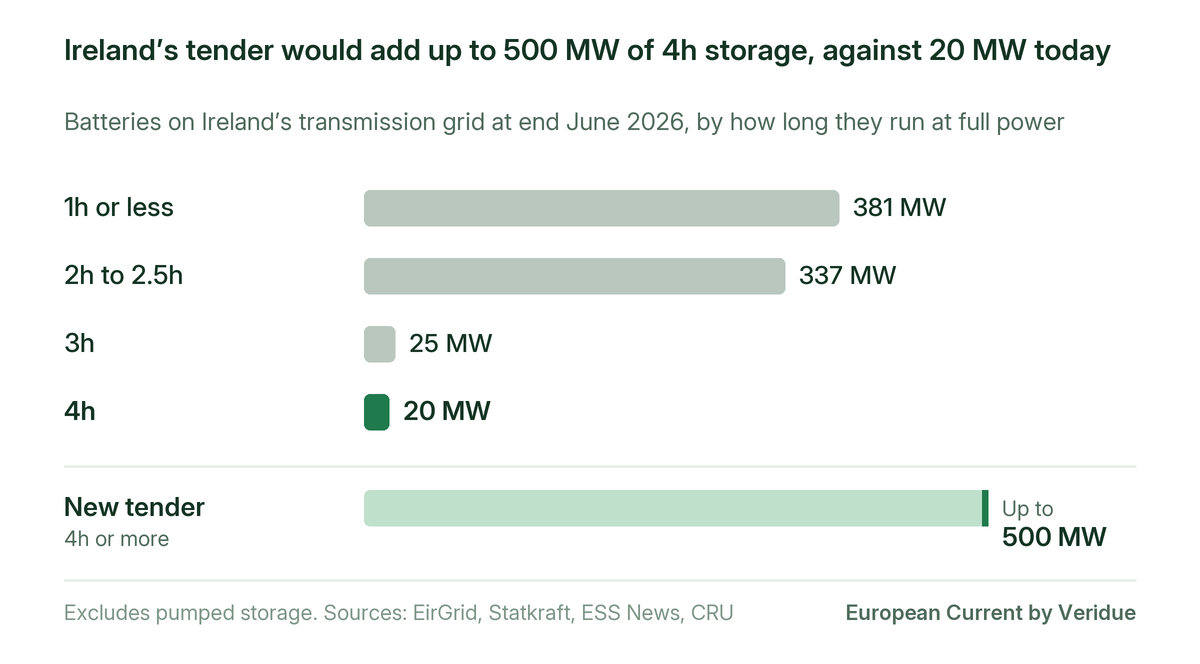
The Commission for Regulation of Utilities (CRU), Ireland’s energy regulator, approved the design of the country’s first tender for long-duration storage on 5 November. EirGrid, the transmission operator, will contract up to 500 MW for 10 years. That equals about two-thirds of the battery capacity on Ireland’s transmission grid today. Any proven technology can bid if it can charge and discharge at full power for at least 4h. Projects must connect to the transmission grid and be 75 to 100 MW, or 20 to 100 MW if they share a site with wind or solar.
Ireland wants storage that can absorb wind and solar power the grid would otherwise waste. In 2025, EirGrid ordered Irish wind farms to turn down their output when the grid could not take their power. They lost 11% of the power they could have generated, and solar farms lost 13%. Most of Ireland’s grid batteries run for 2h or less. The only 4h battery, Statkraft’s 20 MW beside its Cushaling wind farm in Offaly, opened in February. The CRU says the market alone does not pay enough to build longer-duration storage, so it will guarantee part of a project’s revenue.
Bidders compete on a revenue floor: each names the minimum yearly revenue it needs, in euros per MW. If a project earns less than its floor in a year, EirGrid pays the difference and recovers it through network charges. If it earns more, the project keeps 70% of the excess and consumers get 30%. Revenue counts what the project earns from trading, system services, the capacity market and PPAs, less the cost of charging. The floor does not cover operating or financing costs, so bidders must price those into it. EirGrid will cap bids below the yearly cost of owning a 4h battery. Its adviser AFRY puts that cost at about €146k per MW for a battery built for 2028, counting construction, financing and running costs. The floor can therefore never cover a battery’s full cost, and owners must earn the rest in the market.
In return, EirGrid limits when a contracted project may trade, because its modelling found that 4h batteries trading only for profit would be a net cost to the system. At 10:00 each day, it tells the project the most it may charge and discharge in each period of the next day. It can stop the project discharging when that would add to local congestion, or charging when demand peaks. Within those limits, the owner still decides when to charge and discharge. A project that trades outside the limits pays a charge, and one that trades too little has its floor cut.
By comparison, Britain’s cap-and-floor scheme for long-duration storage also guarantees a minimum revenue, but it requires 8h and runs for 25 years. Italy’s storage auctions pay a fixed premium for 15 years, and the owner gives up the right to trade. Ireland asks for less duration, offers a shorter contract and lets the owner keep trading within EirGrid’s limits.
EirGrid will score bids 50% on cost and 30% on how much curtailed wind and solar power a site could absorb. The last 20% goes only to projects that share a site with renewables or use a grid connection that already exists. Baringa, the CRU’s adviser, warns that this could steer contracts to batteries that are already built. For developers, the best-placed projects are 4h batteries beside wind or solar farms in the areas with the most curtailment.
What to watch: the CRU approved the floor and the trading limits only in principle. EirGrid will consult on the contract terms later in 2026, which should settle the maximum bid, whether the floor rises with inflation and how the trading limits are set. It plans to open the tender in 2027 and award contracts in 2028.
🇪🇺 Across markets
EU-wide and cross-border developments
Sweden and Norway give notice to end the Nordic reserve-market agreement in May 2027
6 November · Market Design Announcement · ↓ Potential Headwind
Fingrid, Finland’s transmission operator, said that Svenska kraftnät and Statnett, its Swedish and Norwegian counterparts, have given notice to end the Nordic agreement on reserve markets in May 2027. The agreement is the basis for the joint Nordic capacity markets for aFRR and mFRR, the reserves that restore the grid’s frequency. The two operators want to renegotiate how the costs of running these markets are shared, and Fingrid wants the cooperation to continue. Nordic batteries sell aFRR and mFRR capacity across borders through these markets, which now need a new agreement by May 2027.
Europe’s day-ahead market plans an order type for batteries from late 2027
11 November · Market Design Announcement · ↑ Potential Tailwind
OKTE, Slovakia’s market operator, announced that the EU’s coupled day-ahead market plans a new order type for batteries, called “Storage Orders”. Today, a battery operator must forecast prices and place separate orders to buy and to sell. With a Storage Order, it would submit the battery’s capacity, power, efficiency and costs, and the market’s algorithm would decide when it charges and discharges. OKTE expects the product in late 2027 or early 2028, after testing and regulatory approval. Batteries could capture day-ahead price spreads without forecasting each hour’s price themselves.
🇧🇪 Belgium
EU Commission clears €2 billion of Belgian support for a 735 MW offshore wind farm
9 November · Taxes, Subsidies and Public Programmes Decision · ↑ Tailwind
The EU Commission cleared up to €2.04 billion of Belgian state aid for the first offshore wind farm in the Princess Elisabeth Zone, of up to 735 MW. The tender’s winner gets a 20-year two-way contract for difference. It pays on the power the wind farm could have produced from the wind available, not on what it actually generates. The wind farm keeps its support when curtailed, but gets none when prices are negative, so it has no reason to generate then. Bidders must show that their turbines do not depend on suppliers outside Europe. Belgium can now run the tender, with a result expected in late 2027.
🇨🇿 Czechia
Czech government approves a bill to cap generators’ revenues when prices spike
9 November · Market Design Bill · ↓ Potential Headwind
The government approved a bill that would let it cap what power generators earn in an “extraordinary market situation”, as Czechia did in the 2022-23 energy crisis. Generators would pay the state a levy on revenue above the cap, and the levy would fund a cut in customers’ bills. It could set a separate cap for nuclear, coal, gas and renewables. The industry minister could not say what price level would trigger it. If parliament passes the bill, merchant wind and solar plants would keep only revenue up to the cap when prices spike, and the government could change that cap at any time without asking parliament.
Czech grid operators refused 28 GW of connection requests because the grid was full
6 November · Grid Report · ↓ Headwind
ERÚ, Czechia’s energy regulator, tracks how distribution grid operators handle requests to connect new generators. Its update for the first half of 2026 shows that developers filed 20,804 requests, 38% fewer than a year earlier. Operators turned down requests for 36,208 MW of capacity. They refused most of it, 28 GW or 78%, because the grid had no spare capacity, almost as much as the 31 GW refused for that reason a year earlier. Operators connected only 362 MW of new plants, against 570 MW a year earlier. Fewer developers are applying, but the grid is still too full to take most of the capacity they want to connect.
🇫🇮 Finland
Finland sets the rules for offshore wind tenders in its economic zone
9 November · Siting, Permitting and Land Use Decree · • Neutral
A government decree, in force from 1 December, sets how Finland will choose developers for its offshore wind areas. Bidders need a balance sheet of €600 million and experience of building 200 MW of wind. Half of the 100 points go to the yearly fee a bidder offers the state: a fee of €8,000 per MW earns all 50, unless a rival offers more. Experience and environmental commitments earn up to 34. Most of the last 16 go to bidders that also build at least 100 MW of power-to-X plant, such as hydrogen electrolysers, on the same connection. Only large, experienced groups can bid, and they compete mainly on the fee.
🇮🇪 Ireland
Ireland and Northern Ireland set the volumes for the 2029-30 capacity auction
10 November · Market Design Decision · • Neutral
The SEM Committee, which regulates the all-island power market, set the volumes for the capacity auction for 2029-30. It will seek 7,361 MW of de-rated capacity in Ireland and 2,203 MW in Northern Ireland. A third of Ireland’s volume, 2,426 MW, must be located in Dublin. The Committee declined part of the extra volume the grid operators requested, because buying it would have raised the cost to consumers by almost a quarter. Batteries that can connect in Dublin will compete for a volume reserved for that area.
🇮🇹 Italy
Italy refunds more of gas plants’ costs to cut the power price by about €15 per MWh
9 November · Market Design Decree · ↓ Potential Headwind
The Council of Ministers approved a decree-law that changes two refunds of gas-fired plants’ fuel costs, so that the plants bid lower in the wholesale market, leading to lower power prices. From 1 January 2027, the first refund covers more of the tariff the plants pay to transport gas. The second, an extra refund sized by ARERA, the regulator, applies when gas costs more than €58.9 per MWh, the government says, and lasts at most 18 months. The environment minister expects power prices to fall by about €15 per MWh. Merchant wind and solar plants would earn less per MWh, while plants on fixed-price support contracts would not.
🇱🇻 Latvia
Latvia plans to screen the owners and equipment makers of grid-connected plants
6 November · Grid Bill · ↓ Potential Headwind
The government approved a bill, now before parliament, to screen who owns and equips plants that connect to the transmission grid, on national security grounds. A developer would have to show that the makers of its plant’s control and information systems are registered in the EU, NATO, the European Free Trade Association or one of NATO’s Indo-Pacific partners. Its owners and board members would face matching tests, and AST, the transmission operator, could refuse a connection. Projects that use control systems from makers registered elsewhere, such as in China, or whose owners are based elsewhere, could be refused a connection.
🇳🇱 Netherlands
The Netherlands sets an indicative target of 110 GWh of batteries by 2040, about 50 times today’s fleet
9 November · Grid Announcement · ↑ Potential Tailwind
The cabinet set an indicative target of 110 GWh of batteries by 2040, about 50 times the 2.1 GWh installed at the end of 2025. That is 28 GW of power, or about 4h of storage on average. The figure comes from a storage agenda agreed with the grid operators and ACM, the regulator. Its 25 actions include publishing where storage can be sited. ACM is studying how batteries help the grid, and the cabinet may use the results to redesign network tariffs for storage. The target is not binding, so the tariff review is the part that could change battery returns.
The Netherlands keeps its first capacity auction on schedule for 2028
5 November · Market Design Announcement · ↑ Potential Tailwind
The cabinet told parliament that the design of its capacity mechanism, which it chose in June, is on schedule. TenneT, the transmission operator, will buy capacity in a first auction in 2028, for delivery in 2029-30. The draft rules go out for consultation in the second quarter of 2027. Consumers will pay through grid tariffs, and those who use more power at times of scarcity will pay more. On 10 November, MPs adopted a motion asking for the full proposal by July 2027. The mechanism is technology-neutral, so batteries can plan for a first Dutch capacity auction in 2028.
🇳🇴 Norway
Norway’s grid operator stops reserving capacity for new data centres until 2027
9 November · Grid Decision · ↓ Headwind
Statnett, Norway’s transmission operator, has stopped reserving grid capacity for new data centres. It says they change their load quickly, and it first wants technical requirements for connecting them safely. It will write those by 1 August 2027 at the latest. Data centres already hold 4,200 MW of reserved capacity and 9,100 MW more is queued, against national peak demand of about 25,000 MW. Statnett also told the regulator that the grid it plans for Central Norway cannot serve every mature request, and that only more local generation could. New data centres must wait, while Statnett says it needs more generation in Central Norway.
🇵🇹 Portugal
Portugal no longer lets developers add batteries to reserved grid connections through hybridisation
12 November · Grid Order · ↓ Headwind
Since 13 November, Portugal no longer lets developers add a grid-charging battery to a reserved grid connection through “hybridisation”. Hybridisation lets the holder of a grid capacity reservation add a second technology to the connection before the first plant is built. A ministerial order deleted the line that covered batteries, because the law allows hybridisation only for generation, and a battery is not generation. It does not say what happens to requests already filed. Some holders can still replace up to 20% of their reserved capacity with storage. That leaves the storage auctions we covered in Issue 09 as the main new route to a grid connection for batteries.
🇷🇴 Romania
Romania proposes to exempt co-located batteries from its €30 per kW build guarantee
12 November · Siting, Permitting and Land Use Proposal · ↑ Potential Tailwind
ANRE, Romania’s energy regulator, proposes to exempt batteries added to a generating site from its build guarantee. A developer posts the guarantee when it applies for a permit to build a plant, and loses it if the plant is not finished within the permit period. The revised draft sets it at €30 per kW, so a 100 MW solar farm would post €3 million. Comments are due within 10 days of 12 November. A solar farm that adds a battery would post a guarantee on the solar capacity only, while a standalone battery would pay in full.
🇪🇸 Spain
Spain reopens 935 MW of grid access at the Mudéjar node in Aragón
11 November · Grid Order · ↑ Tailwind
The energy ministry reopened grid access at the Mudéjar 400 kV node in Teruel, the former connection of the Andorra coal plant, where 935.1 MW is available. The capacity was awarded in 2022 and became free when the winning project was changed. It now goes to complete applications in the order they are filed. Applicants must post €80 per kW, on top of the national guarantee of €40 per kW, so a 100 MW project ties up €12 million. Solar and wind developers near the node gain a rare route to firm grid access, and the first complete application wins.
🇸🇪 Sweden
Sweden’s 2027 budget backs SEK 67.6 billion of grid investment and drops three interconnectors
12 November · Grid Budget · • Neutral
The 2027 budget bill asks parliament to back Svenska kraftnät’s plan to invest SEK 67.55 billion (about €6 billion) in the transmission grid from 2027 to 2029. The plan includes a new 400 kV line between Piteå and Umeå, which adds capacity between Sweden’s two northern price zones. It drops three planned interconnectors: Konti-Skan Connect to Denmark, and Aurora Line 2 and Fenno-Skan 3 to Finland. Parliament votes on 15 December. Wind and solar projects in the north get more capacity to move power south, but no new export capacity to Denmark or Finland.
🇬🇧 United Kingdom
Britain exempts manufacturers from two energy levies from 2027
6 November · Taxes, Subsidies and Public Programmes Regulation · • Neutral
New regulations exempt eligible manufacturers from two energy levies, under the British Industrial Competitiveness Scheme. From 1 April 2027, they stop paying for the Renewables Obligation, the older scheme under which suppliers buy certificates from accredited wind and solar plants. From 1 October 2027, they stop paying for the Capacity Market. Suppliers must still buy the same total number of certificates, spread over less electricity, so the obligation for 2027-28 is expected to rise from 0.369 to about 0.394 certificates per MWh. Renewables Obligation plants keep the same demand for their certificates, and exempt manufacturers become cheaper to supply, which makes them stronger PPA buyers.
Consultation & funding diary
Consultations, calls for evidence and funding rounds in this edition, with closing dates as at 16 November 2026. All items link to their source.
Closing by 18 November
🇩🇰 Denmark ↑ Potential Tailwind
Denmark proposes a grid-acceleration area for Aarhus-Aabenraa🇩🇰 Denmark • Neutral
Energinet proposes new reactive-power rules for large loads🇳🇱 Netherlands ↑ Potential Tailwind
ACM proposes time-of-day grid tariffs for large connectionsLooking ahead
19 to 30 November
19 Nov · 🇮🇪 Ireland • Neutral
CRU reviews how Irish network tariffs are structured
20 Nov · 🇦🇹 Austria ↑ Potential Tailwind
E-Control proposes 2027 grid tariffs with a new tariff for flexible withdrawal
20 Nov · 🇧🇪 Belgium • Neutral
CREG consults on Elia’s 2027 exemption from the 70% cross-border capacity rule
20 Nov · 🇱🇻 Latvia • Neutral
Latvia’s regulator consults on when developers pay the deposit that reserves grid capacity
20 Nov · 🇳🇴 Norway ↑ Potential Tailwind
Norway proposes faster connection for small solar
22 Nov · 🇷🇴 Romania ↑ Potential Tailwind
ANRE consults again on the €30 per kW build guarantee for new plants
23 Nov · 🇸🇪 Sweden • Neutral
Ei proposes how to set grid companies’ revenue caps for 2028 to 2031
24 Nov · 🇮🇹 Italy ↑ Potential Tailwind
Terna runs its second MACSE storage auction, for delivery in 2029
26 Nov · 🇸🇪 Sweden ↑ Potential Tailwind
Ei asks when conditional connection agreements can be permanent
27 Nov · 🇪🇸 Spain • Neutral
Spain updates the regulated payment parameters for renewable plants
December
2 Dec · 🇸🇪 Sweden ↑ Potential Tailwind
Svenska kraftnät opens its 2027 procurement of fast frequency reserve
8 Dec · 🇮🇪 Ireland ↑ Potential Tailwind
Tonn Nua offshore grid plans open for comment
9 Dec · 🇬🇧 United Kingdom • Neutral
Britain consults on Wholesale Contracts for Difference for existing generators
11 Dec · 🇬🇧 United Kingdom • Neutral
Ofgem minded to reject lower standing charges for large, little-used connections
17 Dec · 🇪🇺 European Union • Neutral
ACER consults on its model of EU flexibility needs
Further reading
🇧🇪 Belgium
Belgium’s grid connection queue shortens, but storage projects still wait for their first studies
🇭🇷 Croatia
Croatia’s regulator orders the grid operator to state each project’s expected curtailment
🇮🇹 Italy
Italy lets plants up to 1 MW claim FER X support without an auction
🇵🇹 Portugal
Portugal orders connection rules for data centres and electrolysers by 11 December
🇪🇸 Spain
Spain’s 2025-2030 transmission plan clears its environmental review
| Red flag reviews in under 24 hours, with every finding traced to its source document. | Get started → |
What are you seeing in your market? Have a suggestion, spotted something we’ve missed, or know a development we should track in a future edition? We’d love to hear from you. Leave a comment on the website or email us at [email protected].
