


About Veridue The AI-native due diligence and M&A platform for energy infrastructure and data centres Investors, IPPs, developers and lenders use it to run the whole deal, from screening to virtual data room, Q&A and due diligence. Red flag reviews that took 1 to 3 months now take under 24 hours, with every finding traced to its source document. Book a demo → |
Each week we track the European regulations that impact renewables projects’ revenues, costs and timelines, from capture prices, balancing markets and auction rules to grid charges, connection queues and permitting.
It is written for investors, developers and independent power producers, their legal, technical, commercial and financial advisers, and anyone who wants to keep up with the biggest changes in European energy.
Read the takeaways for the week’s bigger themes, jump to the markets you follow, or spend a few minutes with our market deep dive. We cover the smaller changes too: the relevant update for your project may not be the biggest European headline.
This week’s takeaways
- Britain proposes a new CfD for existing wind and solar farms. Owners could swap market revenue for a guaranteed strike price for 5 or 10 years from 2028. Plants that stay out remain subject to the Electricity Generator Levy, a windfall tax on high power prices, which will now run until the last of these contracts ends. That is this week’s deep dive.
- Data centres are crowding grid queues. Britain will let strategic data centres jump its connection queue, Fingrid cannot process every application before 2027, and data centres already hold half of Norway’s reserved grid capacity.
- Battery markets are evolving rapidly. Portugal opened its first auctions for storage grid capacity since 2021, Lithuania’s balancing market is filling up after 392 MW of new batteries, and Hungary’s first flexibility report finds the system could be up to 2 GW short for about 150 hours a year by 2030.
Find your market
🇪🇺 Across markets · 🇧🇪 Belgium · 🇨🇿 Czechia · 🇩🇰 Denmark · 🇪🇪 Estonia · 🇫🇮 Finland · 🇫🇷 France · 🇬🇷 Greece · 🇭🇺 Hungary · 🇮🇪 Ireland · 🇮🇹 Italy · 🇱🇹 Lithuania · 🇱🇺 Luxembourg · 🇳🇱 Netherlands · 🇳🇴 Norway · 🇵🇹 Portugal · 🇷🇴 Romania · 🇸🇪 Sweden · 🇬🇧 United Kingdom
Market deep dive · Deadline diary
Covers 23 to 29 October 2026. Consultation dates as at 30 October 2026.
How to read this
↑ Tailwind ↓ Headwind • Neutral
Tailwind helps the businesses affected. Headwind adds cost, delay or risk. Neutral means no clear overall benefit or drawback, though the change may still matter.
Potential means the effect depends on a proposal being adopted or another condition being met. Consultations are proposals open for feedback. They are listed with their closing dates in the diary at the end.
Our six themes
Market Design · Taxes, Subsidies and Public Programmes · Siting, Permitting and Land Use · Grid · Environmental Markets · Supply Chains
The regulatory picture
Updates in this edition, by market and likely effect. Bar length shows how many updates we cover, not how big their impact is. Consultations in the diary are included, and cross-border measures appear in each affected market. Select a market to jump to its section.
↑ Tailwind • Neutral ↓ Headwind
| Across markets | 6 | |||||||||||
| Belgium | 2 | |||||||||||
| Czechia | 1 | |||||||||||
| Denmark | 4 | |||||||||||
| Estonia | 2 | |||||||||||
| Finland | 2 | |||||||||||
| France | 1 | |||||||||||
| Greece | 1 | |||||||||||
| Hungary | 1 | |||||||||||
| Ireland | 3 | |||||||||||
| Italy | 1 | |||||||||||
| Lithuania | 1 | |||||||||||
| Luxembourg | 1 | |||||||||||
| Netherlands | 3 | |||||||||||
| Norway | 3 | |||||||||||
| Portugal | 1 | |||||||||||
| Romania | 1 | |||||||||||
| Sweden | 3 | |||||||||||
| UK | 11 | |||||||||||
This week’s deep dive
🇬🇧 United Kingdom · Market Design
Britain proposes a new CfD for existing wind and solar farms
The Department for Energy Security and Net Zero opened a consultation on 28 October on a Wholesale Contract for Difference (WCfD) for wind, solar and other low-carbon plants that are already running. It works like the CfDs Britain auctions for new projects. The generator is paid the difference when the wholesale price is below its strike price, and pays back the difference when the price is above it. What is new is who can bid and for how long. The WCfD is open only to existing plants, contracts would last 5 or 10 years, and the government plans a single auction rather than yearly rounds. Its main aim is to shield consumers from gas price spikes.
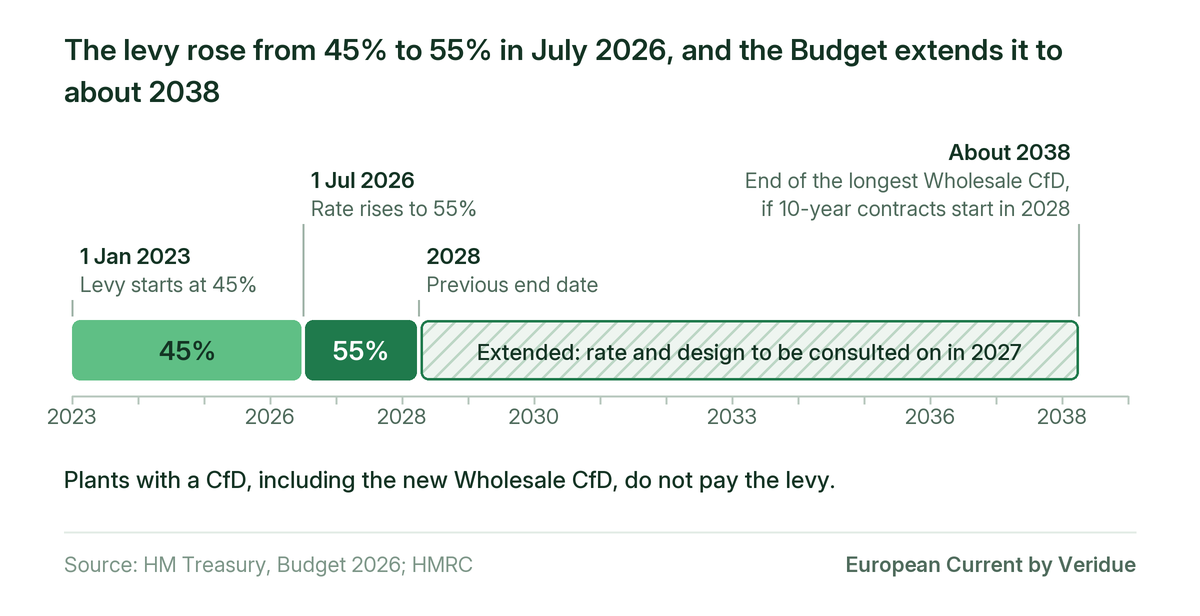
The scheme is tied to the Electricity Generator Levy, a windfall tax introduced in 2023 on older wind, solar and other low-carbon plants that earn high prices when gas sets the power price. It takes a share of their revenue from power sold above a benchmark price, now £82.61 per MWh. That share rose from 45% to 55% on 1 July 2026: at a price of £120 per MWh, a generator now keeps £99.44 and pays £20.56. The levy was due to end in 2028. The Budget, published on the same day as the consultation, extends it until the longest WCfD ends, while WCfD holders are exempt.
The government proposes to include solar, onshore and offshore wind, run-of-river hydro, tidal and geothermal. It proposes to exclude standalone batteries and to treat co-located BESS as under the standard CfD. Under the lead proposal, plants on the Renewables Obligation, the older subsidy scheme, can bid and keep that subsidy, while the government is still deciding whether plants with no subsidy can take part. It estimates that up to 33.2 GW could be eligible, or 29.8 GW if only plants above 5 MW can bid.
The government expects to hold the auction towards the end of 2027 and is considering sealed bids, with every winner paid the clearing price. Contracts are expected to start from 2028, and it has not yet decided whether strike prices will rise with inflation. It is also considering not publishing price caps or budgets in advance, so that the Secretary of State can set the budget after seeing the bids. As under the standard CfD, nothing is paid during negative-price hours, and a contract can end early only for decommissioning or repowering.
Owners of operating wind and solar farms now face a choice: keep merchant revenue taxed by the levy for longer, or lock in a fixed price for up to 10 years. The government itself warns that the scheme may discourage long-term power purchase agreements and thin the forward market, so buyers of corporate PPAs may find fewer sellers.
What to watch: the consultation closes on 9 December. The minimum plant size, the contract length, inflation indexation and whether plants holding Capacity Market agreements can bid will decide how attractive the contract is to plant owners. A separate consultation on the levy’s design after March 2028 follows in 2027.
🇪🇺 Across markets
EU-wide and cross-border developments
EU Commission backs Mediterranean clean-power projects with €4.5 billion of guarantees
26 October · Taxes, Subsidies and Public Programmes Funding · ↑ Tailwind
The EU Commission launched the T-MED Investment Platform, which offers up to €4.5 billion of guarantees to clean-energy projects in the EU’s Mediterranean partner countries. A guarantee covers part of a lender’s loss if a project fails, so banks can lend on easier terms. It covers renewable power, hydrogen, grids and storage, and aims to mobilise up to €25 billion of investment by 2035. Named projects include a €1.6 billion Egyptian grid programme and two 100 MW solar plants in Tunisia. Developers active in Egypt and Tunisia gain a cheaper route to debt, though the Commission has not yet said how to apply.
🇧🇪 Belgium
Belgian regulator may lower the capacity threshold for curtailing solar and wind
23 October · Market Design Decision · ↓ Potential Headwind
In its response to Elia’s first assessment of Belgium’s flexibility needs, the federal regulator CREG set out how surplus solar and wind output should be handled before plants are curtailed. It wants storage, demand flexibility and price-responsive generation used first, and sees no need for a new flexibility subsidy. Elia can already order plants of 25 MW and above to curtail, and distribution operators plants from 1 MW in Flanders and Brussels and 250 kVA in Wallonia. If those thresholds prove too high, CREG would lower them before using the emergency grid defence plan. Smaller solar and wind plants could face curtailment orders.
🇪🇪 Estonia
Estonia pays municipalities up to €5 million to plan wind farms
29 October · Taxes, Subsidies and Public Programmes Regulation · ↑ Tailwind
Estonia’s Minister of Energy and Environment created a grant, the wind momentum bonus, for municipalities that plan wind farms of at least five turbines. Each municipality can receive up to €5 million: the first part once it adopts a spatial plan for a wind farm, the second once the turbines receive building permits. The budget is at least €12 million for 2027 and 2028, paid from carbon allowance auctions, and the first round is expected to open in November. Onshore wind developers gain a concrete reason for councils to approve their plans, although permits and environmental assessments are unchanged.
🇫🇮 Finland
Fingrid cannot process all grid connection applications before 2027
23 October · Grid Announcement · ↓ Potential Headwind
Fingrid, Finland’s transmission operator, says it is struggling to handle a surge in grid connection applications, mostly from data centres and battery storage. Developers are rushing to sign before the rules change, and Fingrid will not process every application by the end of 2026. Under a draft bill, from 1 January 2027 Fingrid would hand out grid capacity for consumers and storage in rounds, ranking projects by priority. Any project without a signed connection agreement by then would have to apply under the new rules. Battery projects that miss the year-end deadline face rules that are not yet final.
Fingrid brings back its balancing fee at €0.64 per MWh from January
27 October · Market Design Announcement · • Neutral
Fingrid will charge a balancing fee of €0.64 on every MWh produced or consumed in Finland from 1 January 2027. The fee pays for the reserves that keep the grid balanced. Fingrid set it to zero in October and November because reserve costs were lower than forecast, but it is now returning at €0.20 per MWh in December. The fee fell from €1.73 per MWh at the start of 2025 to €1.35 at the start of 2026. Finnish wind, solar and battery output pays the fee again, though at about half its early-2026 level.
🇫🇷 France
France lets subsidised renewables sell balancing services and sets a floor on exit penalties
28 October · Taxes, Subsidies and Public Programmes / Market Design Decree · • Neutral
A decree in force since 29 October lets plants on a feed-in tariff or a contract for difference sell system services and offer energy in the balancing mechanism. They are still paid support on the output they would otherwise have produced. Ministers will also set a new interval for calculating the premium, which has so far been hourly. Leaving a support contract early already carried a penalty based on the support received. Now, the decree adds a minimum of €10,000 per MW. Subsidised solar and wind gain a new revenue stream from balancing, but plants that have received little support now pay more to leave.
🇭🇺 Hungary
Hungary’s first flexibility report finds a shortfall of up to 2 GW for about 150 hours a year
22 October · Market Design Decision · ↑ Potential Tailwind
MEKH, Hungary’s energy regulator, approved the country’s first flexibility needs assessment, prepared by MAVIR, the transmission operator. It estimates that by 2030 the system will lack enough flexible capacity to follow hourly changes in demand and generation for about 150 hours a year. In those hours the shortfall averages 240 MW and can reach about 2,000 MW (average demand in 2030 is projected to be about 6.4 GW). Hungary now has six months to set a national target for non-fossil flexibility, such as storage, as EU rules require. Batteries gain an official shortfall to fill and a national target to come, though the report wants them to run without operating subsidies.
🇱🇹 Lithuania
Lithuania adds 392 MW of batteries in two months as balancing demand fills up
22 October · Grid / Market Design Announcement · • Neutral
Litgrid, Lithuania’s transmission operator, connected eight battery parks with 392 MW and 919 MWh in August and September, taking Lithuania’s battery fleet to about 1.3 GW. Balancing capacity is now in sufficient supply, so the regulator cut the volume reserved for Energy Cells, the state-owned battery operator, from 30 MW to 20 MW from 1 November. Meanwhile, Litgrid and ESO, the distribution operator, opened a consultation on Lithuania’s first flexibility market plan, which puts the flexible capacity needed by 2035 at 7.13 GW, up from 4.36 GW. Balancing revenue in Lithuania is saturating, but the country expects to need far more flexibility by 2035.
🇳🇱 Netherlands
Dutch grid operators propose reclaiming capacity from projects that never connect
29 October · Grid Proposal · • Neutral
Netbeheer Nederland, the grid operators’ association, asked the regulator ACM to widen the use-it-or-lose-it rule for transmission capacity. Today TenneT can only reclaim capacity that a connected customer leaves unused. The proposal lets it also act against parties that hold contracted capacity but no connection yet, once it reasonably suspects the capacity will stay unused. TenneT would first consult the holder, who could keep the capacity by showing it will still be used, for example by moving it to another project that has a permit. Projects waiting in the queue could gain capacity held by stalled data centres, but a project without its permits could lose its own.
🇳🇴 Norway
Norway warns data centres could turn its power surplus into a deficit
29 October · Grid / Market Design Report · ↑ Potential Tailwind
NVE, Norway’s energy directorate, published scenarios showing that data centres hold about 4 GW of reserved grid capacity, half of Norway’s total. Another 9 GW of data-centre projects are in the queue. Those already holding capacity could use about 25 TWh a year by 2035, against about 3 TWh today. With faster demand growth and no new wind, Norway’s normal-year surplus of about 15 TWh would become a deficit of about 4 TWh, and 2035 prices could be up to 55% higher than expected. NVE therefore wants data-centre demand weighed against other new industry. For generators, higher prices would make new wind and solar more attractive.
🇵🇹 Portugal
Portugal auctions 1,050 MVA of grid capacity for batteries
22 October · Market Design / Grid Auction · ↑ Tailwind
The energy directorate DGEG opened two auctions for grid injection capacity, the first of their kind since 2021. They offer up to 750 MVA for standalone storage and 300 MVA for renewable plants with co-located storage. Both require storage that can run for at least 4 hours at its full rated power, and bidders compete in an ascending-clock auction. New technical rules also require grid-forming and synthetic inertia from storage of 45 MW or more. Battery developers get their first auction route to a Portuguese connection since 2021.
🇸🇪 Sweden
Svenska kraftnät expands EPAD auctions to 20% of transmission capacity
28 October · Market Design Announcement · ↑ Tailwind
Svenska kraftnät, Sweden’s transmission operator, will auction more EPADs (electricity price area differentials), contracts that hedge the gap between a Swedish bidding zone’s price and the Nordic system price. From December 2026 it will offer about 20% of transmission capacity between SE2 and SE3 and between SE3 and SE4, up from about 15%. It is also extending the auctions to SE1 and Lithuania’s price area, while studying longer-term contracts. Wind, solar and storage owners selling in SE3 and SE4 can now hedge more of their area-price risk.
🇬🇧 United Kingdom
UK Budget bars new charges on energy bills until a 2027 cost framework
28 October · Taxes, Subsidies and Public Programmes Budget · ↓ Potential Headwind
The Budget says no new policy costs, the charges on energy bills that fund government schemes, will be added until a Cost Control Framework sets budgets for them during the 2027 spending review. Only costs that lower bills or protect security of supply are exempt. The government will buy clean power only when it lowers bills overall and can connect to the grid. It says the current CfD auction, Allocation Round 8, meets that test. Carbon Price Support, a charge of £18 per tonne of CO2 on fossil-fuel generation, is now confirmed to end in April 2028. Future CfD rounds will have to show they cut bills.
Britain will let strategic data centres jump the connection queue
28 October · Grid Decision · • Neutral
The Department for Energy Security and Net Zero confirmed that NESO, the system operator, will be able to prioritise grid connections for large electricity users that the government names as strategic, such as data centres. NESO can give them capacity that other projects release when they leave the queue. It can also hold capacity for named projects that are not yet ready, or before any project is named. However, from 2030, regional caps based on grid capacity, water and land will limit data-centre connections. The generation and storage queue is unaffected. Other large users, such as industrial sites and non-strategic data centres, lose access to capacity reserved for strategic projects.
Consultation & funding diary
Consultations, calls for evidence and funding rounds in this edition, with closing dates as at 30 October 2026. All items link to their source.
Closing by 6 November
🇪🇺 European Union • Neutral
EU Commission reviews the Emissions Trading System and Market Stability Reserve🇸🇪 Sweden • Neutral
Ei asks how grid companies should publish free capacity🇩🇰 Denmark ↑ Potential Tailwind
Denmark proposes cheaper power for wind and solar neighbours🇬🇧 United Kingdom ↑ Potential Tailwind
Ofgem proposes a register of demand connections🇬🇧 United Kingdom ↑ Potential Tailwind
Ofgem proposes minimum standards for connection customersLooking ahead
7 to 15 November
8 Nov · 🇬🇷 Greece • Neutral
IPTO consults on the environmental study of its grid plans
11 Nov · 🇨🇿 Czechia ↑ Potential Tailwind
Czech regulator proposes 2027 grid charges that bill batteries less for charging
11 Nov · 🇷🇴 Romania • Neutral
ANRE proposes a 1 million lei guarantee for every balance responsible party
12 Nov · 🇪🇪 Estonia ↑ Potential Tailwind
Estonia consults on a capacity mechanism open to storage
13 Nov · 🇮🇪 Ireland / 🇬🇧 United Kingdom • Neutral
SEM Committee proposes T-1 capacity auction parameters
13 Nov · 🇮🇹 Italy • Neutral
Terna consults on grid connection rules for data centres
13 Nov · 🇬🇧 United Kingdom ↑ Potential Tailwind
Ofgem proposes self-build of all sole-use transmission assets
13 Nov · 🇪🇺 European Union ↑ Potential Tailwind
EU priority infrastructure: electricity applications
15 Nov · 🇩🇰 Denmark ↑ Potential Tailwind
Energinet proposes to ease a frequency requirement for large plants
16 to 30 November
18 Nov · 🇩🇰 Denmark ↑ Potential Tailwind
Denmark proposes a grid-acceleration area for Aarhus-Aabenraa
18 Nov · 🇩🇰 Denmark • Neutral
Energinet proposes new reactive-power rules for large loads
18 Nov · 🇳🇱 Netherlands ↑ Potential Tailwind
ACM proposes time-of-day grid tariffs for large connections
18 Nov · 🇳🇱 Netherlands • Neutral
ACM proposes time-of-day grid tariffs for small connections
20 Nov · 🇧🇪 Belgium • Neutral
CREG consults on Elia’s 2027 exemption from the 70% cross-border capacity rule
20 Nov · 🇮🇪 Ireland • Neutral
CRU consults on EirGrid’s 2026-2035 transmission plan
20 Nov · 🇳🇴 Norway ↑ Potential Tailwind
Norway proposes faster connection for small solar
21 Nov · 🇬🇧 United Kingdom ↑ Potential Tailwind
Treasury consults on tax relief for early project costs
23 Nov · 🇪🇺 European Union • Neutral
EU Commission consults on its new Hydrogen Strategy
December to February
8 Dec · 🇮🇪 Ireland ↑ Potential Tailwind
Tonn Nua offshore grid plans open for comment
9 Dec · 🇬🇧 United Kingdom • Neutral
Britain consults on Wholesale Contracts for Difference for existing generators
11 Dec · 🇬🇧 United Kingdom • Neutral
Ofgem minded to reject lower standing charges for large, little-used connections
16 Dec · 🇬🇧 United Kingdom • Neutral
Northern Ireland consults on cost-reflective network tariffs
17 Dec · 🇪🇺 European Union • Neutral
ACER consults on its model of EU flexibility needs
8 Jan 2027 · 🇬🇧 United Kingdom • Neutral
Northern Ireland reviews how generators get firm access
29 Jan 2027 · 🇱🇺 Luxembourg ↑ Potential Tailwind
Creos explores paying businesses to cut Luxembourg’s winter import peaks
31 Jan 2027 · 🇳🇴 Norway • Neutral
Finnmark wind applications gain three months
1 Feb 2027 · 🇸🇪 Sweden ↑ Potential Tailwind
Sweden consults on a central data hub for the electricity market
Further reading
🇪🇺 Across markets
ENTSO-E’s new strategy for Europe’s power system
| Red flag reviews in under 24 hours, with every finding traced to its source document. | Book a demo → |
What are you seeing in your market? Have a suggestion, spotted something we’ve missed, or know a development we should track in a future edition? We’d love to hear from you. Leave a comment on the website or email us at [email protected].
