


Each week we track the regulatory changes across Europe that move a renewables project’s revenues, costs and timelines, from auction rules and balancing markets to grid charges, connection queues and permitting. Start with the summary below, jump to the markets you follow, or read the deep dive.
Covers 12 to 19 November 2026. Consultation dates as at 20 November 2026.
This Week’s Takeaways
🇫🇷 French solar tender prices are back to 2022 levels, but new rules will raise them
The latest ground-mounted solar round was awarded at €61.33 per MWh, 23% below the previous round a year earlier. In France’s next tender, the State will stop compensating solar plants for the low prices they get at midday. On our calculation, a solar plant would then need to bid about €82 per MWh to receive the same revenue as a €61 bid gives today. That is this week’s deep dive.
🇩🇰 🇭🇺 🇵🇹 🇪🇺 Grid capacity is still the bottleneck
In Denmark, wind and solar farms have asked for 2.5 GW more than the transmission grid has room for. Hungary’s wind grid tender drew bids for 2.6 times the capacity on offer. Portugal’s €1.58 billion distribution plan adds only 3% more room for new plants. Meanwhile, the EU agreed permit deadlines for grids and stand-alone storage.
🇪🇺 🇸🇪 🇩🇰 Market rules are making more room for storage and flexibility
ACER wants capacity markets to rate batteries by their de-rating factor, not by a minimum duration. Sweden will let traders adjust their positions until 30 minutes before delivery, from March 2027. Denmark proposes to let independent aggregators trade in the day-ahead and intraday markets.
The Regulatory Picture
Updates in this edition, by market and likely effect. Bar length shows how many updates we cover, not how big their impact is. Cross-border measures appear in each affected market. Select a market to jump to its section.
↑ Tailwind • Neutral ↓ Headwind
| 🇪🇺 Across markets | 3 | ||||
| 🇧🇬 Bulgaria | 1 | ||||
| 🇨🇿 Czechia | 3 | ||||
| 🇩🇰 Denmark | 2 | ||||
| 🇫🇮 Finland | 1 | ||||
| 🇫🇷 France | 2 | ||||
| 🇬🇷 Greece | 1 | ||||
| 🇭🇺 Hungary | 1 | ||||
| 🇮🇪 Ireland | 2 | ||||
| 🇮🇹 Italy | 3 | ||||
| 🇳🇱 Netherlands | 1 | ||||
| 🇵🇹 Portugal | 1 | ||||
| 🇷🇴 Romania | 1 | ||||
| 🇪🇸 Spain | 1 | ||||
| 🇸🇪 Sweden | 4 | ||||
| 🇬🇧 UK | 2 |
Deep Dive: 🇫🇷 French solar tender prices are back to 2022 levels, but new rules in the next tender will raise them
🇫🇷 France · Taxes, Subsidies and Public Programmes · ↓ Potential Headwind · about 3 min read
What happened
CRE, France’s energy regulator, backed the draft rules for France’s next renewables tender on 5 November. The tender is technology-neutral: solar, onshore wind and hydro projects compete against each other for 500 MW of 20-year support contracts, with a maximum bid of €100 per MWh. It is the first round of the “PPE3 neutral” tender, named after France’s 2026-2035 energy plan. The ministry has not yet published the bid date, and CRE warns that bidders will get short notice.
Where tender prices stand
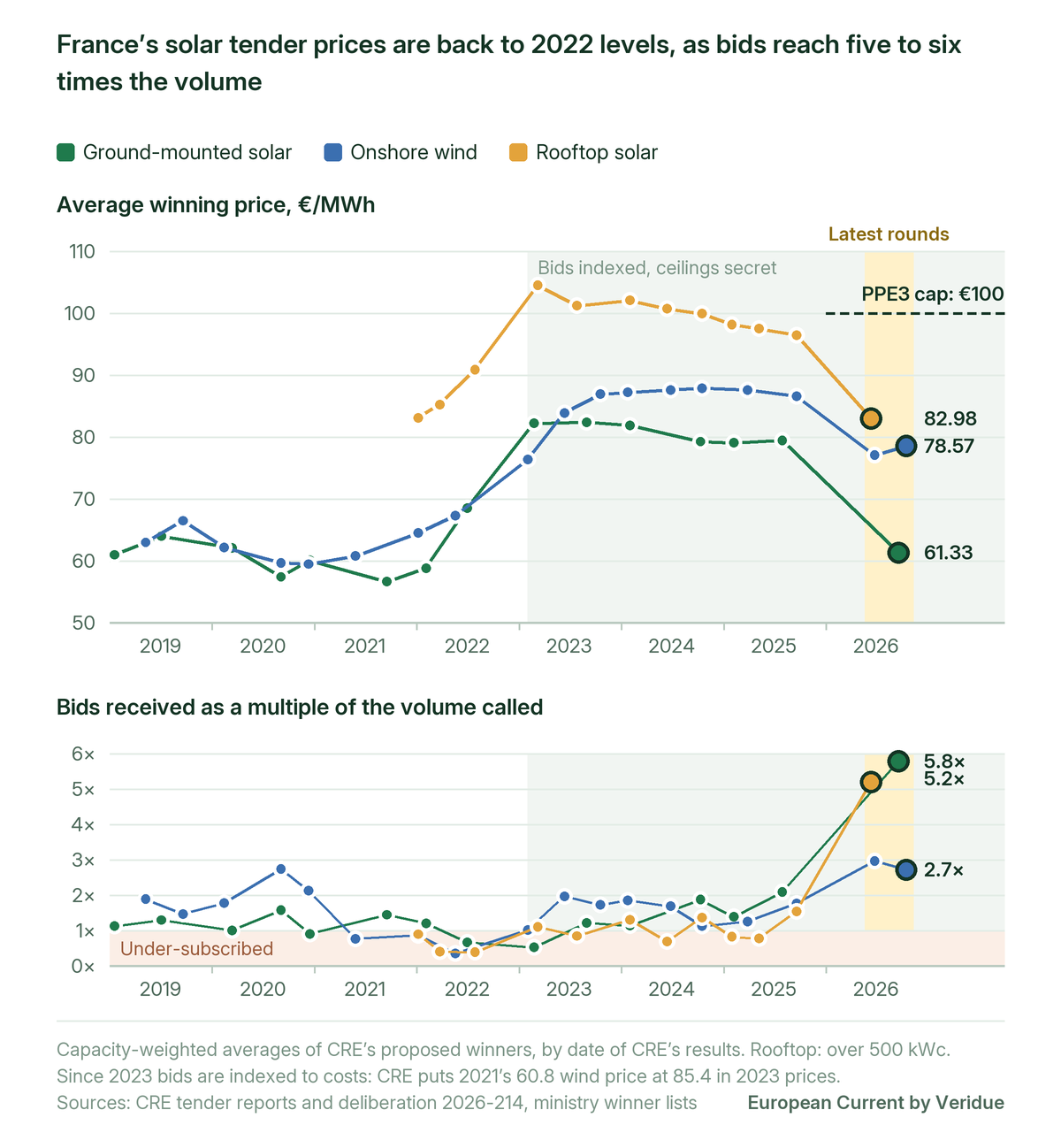
Ground-mounted solar won at €57 to €64 per MWh from 2019 to early 2022, then at €79 to €82 from 2023 to 2025. Part of the rise was inflation: CRE calculates that the €60.8 per MWh onshore wind won at in 2021 equals €85.4 in 2023 prices. In the latest solar round, awarded in October, the average winning price was €61.33 per MWh. That is 23% below the previous round a year earlier (€79.48), and bids reached 5.8 times the volume on offer. Onshore wind has fallen less, from a peak of €87.92 in late 2024 to €78.57 in October.
What the new rules change
Winners sell their power on the market. The State then pays them the difference between the price they bid and a reference price, so that they end up with their bid price. If the reference price is higher than the bid, the winner pays the difference to the State.
Until now, the reference price for a solar plant was the average price that solar plants get on the market. That price is low and falling, because solar plants all produce at midday and push the price down in those hours. This is known as cannibalisation, and so far the State has paid for it. In the new tender, the reference price is the average market price across all hours, the same for every technology. CRE says the main aim is to stop the State paying for cannibalisation. Solar winners will carry it.
What it means for a solar bid
CRE’s figures for 2025, which exclude hours with negative prices, show the effect. Solar plants sold their power for €43.6 per MWh on average, and the average market price was €63.9. Take a plant that bid €61.33.
Under the old rules, the reference price was €43.6. That is €17.7 below the bid, so the State paid the plant €17.7. Added to the €43.6 from the market, the plant received €61.33.
Under the new rules, the reference price is €63.9. That is €2.6 above the bid, so the plant pays €2.6 to the State. Taken off the €43.6 from the market, that leaves the plant with about €41.
To receive €61.33 again, the plant would have to bid about €82 per MWh, on our calculation. Onshore wind is almost unaffected, because wind farms sold their power at 94% of the average market price in 2025.
What changes when prices are negative
France had 513 hours of negative prices in 2025, and 568 by 8 October 2026. In those hours, winners are compensated for the output they lose, except for a set number of hours each year. That number rises to 30 hours for every technology, from 15 for solar and 20 for onshore wind.
What CRE wants changed
CRE expects bids to rise, and considers the €100 maximum appropriate. It asks the ministry for two changes. The first is a revenue floor. Under the new rules, a solar plant can owe the State more for an hour than it earns on the market, so it would be better off switching off. The second is to let solar projects add a battery and bid before the battery has planning permission. A battery lets a plant sell in higher-priced hours. CRE estimates that a solar plant with a battery would have earned 8% above the new reference price in 2025, where a plant without one earned 32% below.
What to watch: the ministry’s final rules, and whether they include the revenue floor. CRE also asks it to publish tender volumes for 2027 onwards.
Regulation Rundown
🇪🇺 Across markets
EU agrees permit deadlines for grids and stand-alone storage
18 November · Siting, Permitting and Land Use · Bill · ↑ Potential Tailwind
The European Parliament and the Council reached a provisional agreement on a law to speed up permits. Authorities will have to decide permits for power grids, stand-alone storage and charging stations within a maximum time. They will also count as being of overriding public interest, which makes them harder to block on other grounds. The time limits are not yet published. The Commission says transmission projects take more than 10 years today, over half of it spent on permits. Stand-alone BESS gets an EU permit deadline for the first time. Until now, only batteries built alongside a renewable plant had one.
ACER counts €12 billion of security-of-supply support in 2025 and opposes minimum-duration rules for batteries
19 November · Market Design · Report · • Neutral
ACER, the EU energy regulators’ agency, reported that EU countries spent €12 billion in 2025 to secure power supply. Capacity mechanisms, which pay plants to be available, took €6.9 billion of that. ACER wants capacity markets to rate every technology by its de-rating factor, the share of its capacity counted as reliably available, and not to set a minimum duration for batteries. A 4h battery’s de-rating factor is on average 28% lower than a gas plant’s, but the battery costs about 30% less per MW. The report is not binding, but it argues against rules such as Germany’s, whose 2026 auctions require 10h of continuous output.
🇧🇬 Bulgaria
Bulgaria sets permit deadlines of 6 to 12 months in renewable priority zones
12 November · Siting, Permitting and Land Use · Law · ↑ Potential Tailwind
Bulgaria’s president signed changes to the Renewable Energy Act, which apply the EU’s renewables directive. Permits in “priority zones”, areas the government designates for renewables, must be decided within 6 months or 1 year, depending on the project. Wind farms in a zone, and batteries on the same site, are presumed to comply with species-protection law if they follow the zone’s rules. The law also requires a producer with a long-term PPA to hand its guarantees of origin, the certificates that prove power is renewable, to the buyer. The deadlines apply once the government approves the zones.
🇨🇿 Czechia
Czech grid operators propose full re-testing when more than 10% of a plant is replaced
19 November · Grid · Proposal · ↓ Potential Headwind
ERÚ, Czechia’s energy regulator, published for comment new connection rules from ČEZ Distribuce and EG.D, two distribution operators. If more than 10% of a plant’s capacity, inverters or panels is replaced or added, the owner would have to prove that the whole site meets today’s connection rules. All changes since April 2019 count towards the 10%. From 1 September 2027, only accredited inspectors could test plants of 100 kW and above. Comments close 10 December. Repowering older solar plants would mean more time and higher costs.
🇩🇰 Denmark
Denmark restarts grid allocation with room for 17 GW more generation, but stand-alone batteries seem to be excluded
13 November · Grid · Decision · • Neutral
Energinet, Denmark’s transmission operator, has resumed allocating grid capacity, under the priority ranking introduced in October. Counting agreements already signed, the transmission grid has room for another 17 GW of generation, against 18 GW of generation capacity today. It also has room for another 17 GW of demand, against 12 GW today. Wind and solar farms are in the second priority category, where requests exceed the room for generation by 2.5 GW. Batteries are in the third category and get their answers in late November. A battery inside a solar farm’s existing grid connection can still connect, but Energinet says stand-alone BESS looks very hard to connect.
🇫🇮 Finland
Finland’s planned connection rules would let large consumers move up the queue by buying from a local wind or solar plant
13 November · Grid · Announcement · ↑ Potential Tailwind
A draft bill would let Fingrid, Finland’s transmission operator, rank connection requests from new consumers and storage from 2027. A consumer such as a data centre could move up the ranking by making a production commitment. This is an undertaking to buy at least 50% of its yearly consumption from a named power plant in its own region. Fingrid has now set two such regions, north and south of the main bottleneck in its grid, which runs across Central Finland. Wind and solar developers gain buyers: large consumers that need a plant on their side of that line.
🇫🇷 France
France awards 1,006 MW of onshore wind at €78.57 per MWh, 2% above the previous round
13 November · Taxes, Subsidies and Public Programmes · Tender result · • Neutral
CRE, France’s energy regulator, published its report on the 12th round of the onshore wind tender, in which the minister named 63 winners for 1,006 MW. Bids totalled 2,724 MW, 2.7 times the 1,000 MW on offer. The average winning price was €78.57 per MWh, 2% above the €77.08 of the 11th round, awarded in July. It remains 11% below the peak of €87.92 in late 2024. CRE credits strong competition and many repowering bids, which won 28% of the capacity. The 13th round, also for 1,000 MW, takes bids from 7 to 17 December.
🇬🇷 Greece
Greece makes new plants pay their full grid connection cost and requires data centres to use 60% new renewables
17 November · Grid · Law · • Neutral
Greece enacted Law 5356/2026, which applies the EU’s 2024 electricity market directive and changes who pays for grid connections. Plants that had not accepted a final connection offer by 17 November must now pay the full cost of their connection and any grid extension it needs. Under a 2022 law, they could recover 50% of the extension costs. The new law also requires data centres to cover 60% of their yearly consumption from new renewable plants or storage. Projects without an accepted offer lose the refund, while data centres become new buyers of renewable power.
🇭🇺 Hungary
Hungary’s wind grid tender drew bids for 2.6 times the capacity offered, with results due by 13 December
13 November · Grid · Announcement · ↑ Potential Tailwind
MEKH, Hungary’s energy regulator, is checking the 46 bids in its tender for wind-farm grid connections. Together they ask for 1,834 MVA of connection capacity, 2.6 times the 702 MVA that MEKH offered at nine grid nodes. Bidders also plan to build 1,947 MWh of storage alongside their wind farms. Preliminary results are due by 13 December. Winners must obtain a building permit by 1 January 2030. They get their guarantee back if the permit is refused on military grounds.
🇮🇪 Ireland
Irish regulator sets RESS 6 competition ratios at 1.75 for solar and 1.87 for onshore wind
16 November · Taxes, Subsidies and Public Programmes · Decision · • Neutral
The CRU, Ireland’s energy regulator, set the final competition ratios for RESS 6, Ireland’s sixth renewables support auction: 1.75 for solar and 1.87 for onshore wind. Solar and wind bid in separate pots, so each has its own ratio. The ratio caps how much each pot can award: the capacity bidding must be at least 1.75 times the capacity that wins. So at most 57% of the solar capacity offered and 53% of the wind capacity can win support. The CRU publishes the ratios only if it finds enough competition. Both pots go ahead, and close to half of the capacity offered in each will not win.
🇮🇹 Italy
Italy’s first flexibility assessment finds no shortfall to 2035, provided 50 GWh of large batteries are built by 2030
17 November · Market Design · Decision · • Neutral
ARERA, Italy’s energy regulator, approved Terna’s first assessment of how much flexibility the power system needs. Terna, the transmission operator, expects curtailment to rise from under 1% of renewable output in 2025 to 3% in 2030. It still finds that Italy will have enough flexibility until 2035. That finding assumes 50 GWh of utility-scale storage by 2030 and 82 GWh by 2035, which Terna has started to buy through its MACSE storage auctions. The result depends on that storage being built. The second MACSE auction runs on 24 November.
Italy will charge power buyers for the gas-plant refund, but exempt battery charging and older renewable PPAs
13 November · Market Design · Decree · ↓ Potential Headwind
Italy’s decree-law 207 sets out who pays for the larger refund of gas plants’ fuel costs, which the government expects to cut the power price by about €15 per MWh. The cost falls on balance responsible parties, usually electricity suppliers, through a charge that ARERA will set on each MWh their customers consume. Two types of power are exempt: power that batteries store to discharge later, and power from unsubsidised renewable plants built since 2017, if sold under a contract signed before the decree. Parliament must convert the decree into law by 12 January 2027. PPAs signed from now on will carry the charge.
🇳🇱 Netherlands
EU Commission clears up to €9.45 billion of Dutch support for 2 GW of offshore wind at IJmuiden Ver Gamma
17 November · Taxes, Subsidies and Public Programmes · Decision · ↑ Tailwind
The EU Commission approved TOWOZ, a Dutch scheme of up to €9.45 billion for two offshore wind farms of 2 GW in total. Bidders first compete on how much they offer to pay the state for each site. If no bidder offers to pay, the government will accept bids for a subsidy: a premium on top of the market price, paid for 15 years from about 2032. Both tenders must be held before July 2027, when EU rules start to require two-way contracts for difference. Developers can bid knowing that a subsidy is available if no one bids without one.
🇵🇹 Portugal
Portugal approves a €1.58 billion distribution grid plan that adds 3% more room for new plants
18 November · Grid · Decision · • Neutral
The government approved the 2026-2030 investment plan of E-REDES, Portugal’s distribution operator, in a resolution published on 18 November. The plan is worth €1,581 million. The capacity available for new generation rises by only 3%, from 6,941 MVA at the end of 2025 to 7,178 MVA in 2030. E-REDES cannot grant that capacity alone, because it also depends on what the transmission grid can take. The plan leaves storage out, because the rules on charging batteries from the grid are unclear. A solar project that finds room on the distribution grid still needs transmission capacity to connect.
🇸🇪 Sweden
Sweden moves intraday gate closure to 30 minutes before delivery from 9 March 2027
18 November · Market Design · Announcement · ↑ Tailwind
Svenska kraftnät, Sweden’s transmission operator, will move the intraday gate closure, the last moment to trade power before delivery, from 60 to 30 minutes on 9 March 2027, as EU market rules require. The change applies in Sweden’s four bidding zones and on the borders with Finland and Lithuania. Subject to the regulator’s approval, Svenska kraftnät will also accept bids for mFRR, a manually activated balancing reserve, until 25 minutes before delivery instead of 45. Wind and solar plants will be able to correct forecast errors later, and batteries to switch between the intraday market and mFRR closer to real time.
Consultation & funding diary
Consultations, calls for evidence and funding rounds in this edition, with closing dates as at 20 November 2026. All items link to their source.
Closing by 25 November
🇸🇪 Sweden • Neutral
Ei proposes how to set grid companies’ revenue caps for 2028 to 2031🇮🇹 Italy ↑ Potential Tailwind
Terna runs its second MACSE storage auction, for delivery in 2029🇷🇴 Romania • Neutral
Transelectrica drafts rules to pay large consumers for cutting demand in supply crisesLooking ahead
26 to 30 November
26 Nov · 🇸🇪 Sweden ↑ Potential Tailwind
Ei asks when conditional connection agreements can be permanent
27 Nov · 🇪🇸 Spain • Neutral
Spain updates the regulated payment parameters for renewable plants
December
1 Dec · 🇩🇰 Denmark ↑ Potential Tailwind
Denmark consults on letting independent aggregators trade in day-ahead and intraday markets
2 Dec · 🇸🇪 Sweden ↑ Potential Tailwind
Svenska kraftnät opens its 2027 procurement of fast frequency reserve
8 Dec · 🇮🇪 Ireland ↑ Potential Tailwind
Tonn Nua offshore grid plans open for comment
9 Dec · 🇬🇧 United Kingdom • Neutral
Britain consults on Wholesale Contracts for Difference for existing generators
10 Dec · 🇨🇿 Czechia ↓ Potential Headwind
ERÚ consults on Czech grid-code changes that tighten re-testing after repowering
11 Dec · 🇬🇧 United Kingdom • Neutral
Ofgem minded to reject lower standing charges for large, little-used connections
17 Dec · 🇪🇺 European Union • Neutral
ACER consults on its model of EU flexibility needs
January 2027
18 Jan · 🇨🇿 Czechia • Neutral
Czechia proposes to charge for its capacity mechanism mainly in the year’s highest-priced hours
Further reading
Thank you
What are you seeing in your market? Have a suggestion, spotted something we’ve missed, or know a development we should track in a future edition? We’d love to hear from you. Leave a comment on the website or email us at [email protected].
Red flag reviews in under 24 hours, with every finding traced to its source document.
Get started →