


About Veridue The AI-native due diligence and M&A platform for energy infrastructure and data centres Investors, IPPs, developers and lenders use it to run the whole deal, from screening to virtual data room, Q&A and due diligence. Red flag reviews that took 1 to 3 months now take under 24 hours, with every finding traced to its source document. Get started → |
Each week we track the European regulations that impact renewables projects’ revenues, costs and timelines, from capture prices, balancing markets and auction rules to grid charges, connection queues and permitting.
It is written for investors, developers and independent power producers, their legal, technical, commercial and financial advisers, and anyone who wants to keep up with the biggest changes in European energy.
Read the takeaways for the week’s bigger themes, jump to the markets you follow, or spend a few minutes with our market deep dive. We cover the smaller changes too: the relevant update for your project may not be the biggest European headline.
This week’s takeaways
- Germany’s first capacity auction bought only gas plants. It will pay an average of €155,296 a year per de-rated MW (the de-rating factor for gas plants is 85%) for 15 years. That is a third below its cap, but three times Italy’s price and almost ten times Belgium’s for similar contracts. Batteries, wind and solar could not compete, because every plant had to run for 10 hours in a row. That is this week’s deep dive.
- Batteries are winning Belgium’s capacity auctions. New batteries took 63% of the capacity contracted for 2030-31, and they were the largest new technology in the auction for 2028-29.
- Governments are deciding how data centres get onto the grid. Norwegian MPs want to end the right to a connection for new users above 1 MW. Finland will require every data centre above 0.5 MW to report its power demand and grid plans to a national register, so that planners can see what is coming. Belgium cut transmission charges by about 60% for qualifying steady loads, including data centres.
Find your market
🇪🇺 Across markets · 🇦🇹 Austria · 🇧🇪 Belgium · 🇨🇿 Czechia · 🇩🇰 Denmark · 🇪🇪 Estonia · 🇫🇮 Finland · 🇫🇷 France · 🇬🇷 Greece · 🇭🇺 Hungary · 🇮🇪 Ireland · 🇮🇹 Italy · 🇱🇻 Latvia · 🇱🇺 Luxembourg · 🇳🇱 Netherlands · 🇳🇴 Norway · 🇷🇴 Romania · 🇪🇸 Spain · 🇸🇪 Sweden · 🇬🇧 United Kingdom
Market deep dive · Deadline diary
Covers 28 October to 5 November 2026. Consultation dates as at 6 November 2026.
How to read this
↑ Tailwind ↓ Headwind • Neutral
Tailwind helps the businesses affected. Headwind adds cost, delay or risk. Neutral means no clear overall benefit or drawback, though the change may still matter.
Potential means the effect depends on a proposal being adopted or another condition being met. Consultations are proposals open for feedback. They are listed with their closing dates in the diary at the end.
Our six themes
Market Design · Taxes, Subsidies and Public Programmes · Siting, Permitting and Land Use · Grid · Environmental Markets · Supply Chains
The regulatory picture
Updates in this edition, by market and likely effect. Bar length shows how many updates we cover, not how big their impact is. Consultations in the diary are included, and cross-border measures appear in each affected market. Select a market to jump to its section.
↑ Tailwind • Neutral ↓ Headwind
| Across markets | 4 | |||||||||
| Austria | 1 | |||||||||
| Belgium | 3 | |||||||||
| Czechia | 1 | |||||||||
| Denmark | 6 | |||||||||
| Estonia | 2 | |||||||||
| Finland | 1 | |||||||||
| France | 1 | |||||||||
| Greece | 1 | |||||||||
| Hungary | 1 | |||||||||
| Ireland | 4 | |||||||||
| Italy | 3 | |||||||||
| Latvia | 1 | |||||||||
| Luxembourg | 1 | |||||||||
| Netherlands | 1 | |||||||||
| Norway | 4 | |||||||||
| Romania | 1 | |||||||||
| Spain | 1 | |||||||||
| Sweden | 4 | |||||||||
| UK | 9 | |||||||||
This week’s deep dive
🇩🇪 Germany · Market Design
Germany’s first capacity auction buys 5.2 GW, all of it gas
The Bundesnetzagentur, Germany’s network regulator, published the results of the first auction under its new capacity law, the StromVKG, on 3 November. It sought 4,500 MW of de-rated capacity, which counts each plant only for the share of its capacity it can reliably deliver when supply is tight. The de-rating factor for gas plants is 85%. 41 bids offered about 11,958 MW, 2.7 times the volume sought, and 11 won 5,160 MW, slightly more than the target because the last winning bid was awarded in full.
Germany is closing its coal plants by 2038 at the latest and wants renewables to supply 80% of its power from 2030. Until now, it has kept back-up plants in reserves outside the market. This first round was designed to buy new plants that can run for long periods. Every plant had to deliver 80% of its capacity for 10 hours in a row and be able to switch to hydrogen. Wind and solar could not bid at all.
Winners get a yearly payment for 15 years from 1 November 2031, and each is paid its own bid. The award list shows bids from €129,551 to €189,970 per de-rated MW a year. The average is €155,296, 36% below the €244,000 cap. In return, winners pay back any spot price above a strike price. The strike price is not fixed: it is recalculated every day as the fuel and carbon cost of running an open-cycle gas turbine, plus €50 per MWh. A winner therefore swaps its income from price spikes for a steady payment. Consumers will pay through a new levy, which a law due in 2027 will set up. This round alone will cost them about €800 million a year.
LEAG won about 3,000 MW, mostly by converting its Jänschwalde and Boxberg lignite sites to gas, which lets it reuse buildings and grid connections. RWE won about 2,100 MW for new combined-cycle plants in Voerde, Werne and Weisweiler. The two companies took 99% of the volume. Storage could bid only if it can run for at least 10 hours, and even then its de-rating factor is only 58% to 89%, so no batteries won.
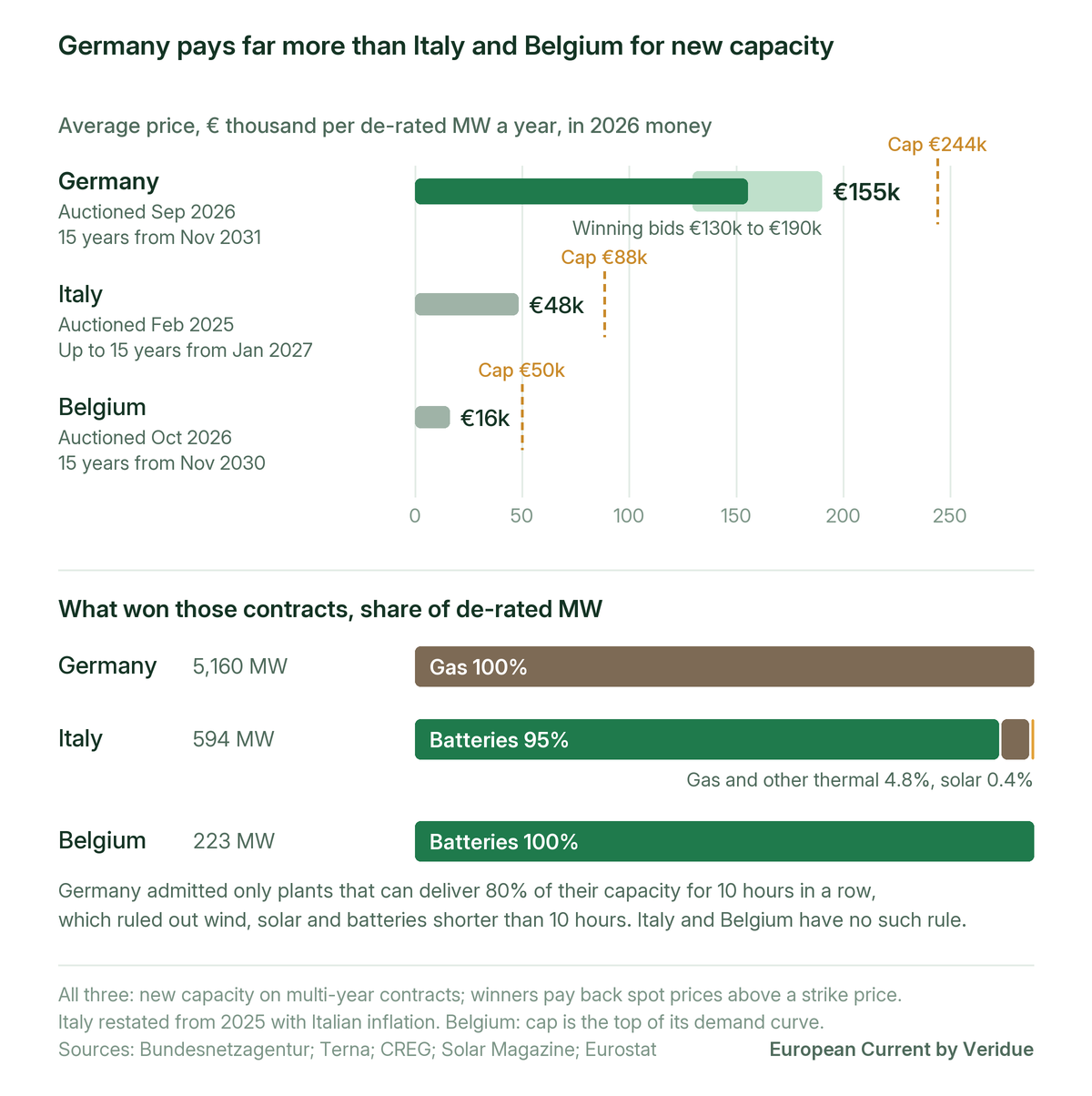
We compare Germany with Italy and Belgium because their capacity markets work the same way: new capacity can get contracts of up to 15 years, and winners pay back price spikes. Britain and Poland, by contrast, let winners keep them. In 2026 money, Germany’s average is three times Italy’s and almost ten times Belgium’s. The difference is what each market let in: batteries won 95% of Italy’s new capacity and all of Belgium’s 15-year contracts. For gas developers, the strong demand bodes well for a second round in Germany on 29 December, which offers about 3,840 MW. Plants in the south, which here includes North Rhine-Westphalia, get a bonus of €16,000 per de-rated MW when bids are ranked.
What to watch: the awards take effect on 10 November, and winners must post their security by 8 December. The second round’s bid date is 29 December, and a 2 GW auction open to all generation, including new wind and solar farms without EEG support, follows on 18 May 2027. The levy that pays for the contracts needs a law in 2027.
🇧🇪 Belgium
Batteries win almost two-thirds of Belgium’s capacity auction for 2030-31
28 October · Market Design Auction · ↑ Tailwind
CREG, Belgium’s energy regulator, validated the results of three capacity auctions run by Elia, the transmission operator. The auction for 2027-28 contracted nothing, because no extra capacity was needed once cross-border contributions were counted. For 2028-29, 1,566 MW of de-rated capacity won, 48% of it gas plants and 38% batteries, at an average of €21,600 per MW a year. For 2030-31, 769 MW won out of about 3,800 MW offered, and new 4h batteries took most of it: 63%. Contracts of more than one year averaged about €16,300 per de-rated MW a year, against a cap of €50,000. Batteries are now the main new technology winning Belgian capacity contracts.
Belgium cuts transmission charges by about 60% for large, steady power users
30 October · Grid Decision · • Neutral
CREG approved a discount on Elia’s transmission tariffs from 1 November for sites using more than 10 GWh a year. A site qualifies as steady if it uses at least 7,000 hours a year at peak power (80% of the hours in a year), or as off-peak if 55% of its use falls off-peak. In 2027 the discounts are 65% and 60%. The 59 qualifying sites are mostly chemical and steel plants, plus data centres run by Google and BNP Paribas. Storage cannot qualify. Elia’s past surpluses cover the €96 million cost, so other users’ tariffs are not set to rise for now. Qualifying steady loads, such as data centres, now pay about 60% less for most Belgian transmission charges.
🇩🇰 Denmark
Energinet plans a 15.8 billion kroner grid to raise North Jutland’s renewables capacity to 8 GW
2 November · Grid Decision · ↑ Potential Tailwind
Energinet, Denmark’s transmission operator, approved a plan worth DKK 15.8 billion (about €2.1 billion) to double the capacity of the 400 kV grid between Aarhus, Aalborg and Viborg. Once the climate ministry approves it, construction would start in late 2030, with the lines in service in stages up to 2037. The region will then be able to host about 8 GW of renewables, against 1.4 GW today. Meanwhile, Energinet is consulting until 13 November on cheaper, curtailable grid access for solar, wind and batteries. North Jutland projects gain a long-term route to connect, but not before the 2030s.
🇪🇪 Estonia
Estonia cuts its state reserve plant’s share of the Baltic reserve market by 100 MW
30 October · Market Design Decision · ↑ Tailwind
Elering, Estonia’s transmission operator, said it will count 100 MW less of its 250 MW Kiisa emergency plant towards the Baltic frequency reserve market from 1 May 2027. The energy minister proposed the cut because private suppliers have entered the market: reserve providers have grown by 185% and their offers by 75%. From around the end of 2027, Elering plans to lease Kiisa to a private operator, so it can sell power in every market instead of being held mostly in reserve. Buying more reserves from the market raises the balancing fee that consumers pay to €3.89 per MWh from May 2027, from €3.73 in 2026. Batteries and other flexible assets will be able to compete for more of the Baltic reserve volume.
🇫🇮 Finland
Finland proposes a register of every data centre above 0.5 MW
29 October · Grid Bill · • Neutral
The government sent Parliament a bill to create a register of every data centre with at least 0.5 MW of IT load, planned, building or operating. New ones would register within 30 days of signing a grid connection agreement. They would report five-year forecasts of their power demand, their grid capacity, water use and any plans for storage, flexibility or waste heat. The law would start on 1 April 2027, with the first public quarterly overview in September. Registering is not a permit. Generators and PPA sellers would get the first official view of a pipeline that already holds over 3 GW of grid agreements with Fingrid.
🇫🇷 France
France sets the rules and the 2030-31 demand curve for its new capacity market
30 October · Market Design Decision · • Neutral
Four ministerial orders set the rules of France’s new capacity mechanism, in which RTE, the transmission operator, buys capacity for all consumers. For 2030-31, the first auction held four years ahead, RTE will aim to contract about 82 GW at up to €72 per kW a year. Existing plants are capped at €15 unless the regulator grants an exemption. New plants and storage that invest at least €125,000 in new equipment per de-rated MW can win contracts of up to 15 years. Only 3 GW of these are on offer, and storage can take at most 0.9 GW. Applications close on 23 November. New batteries can win 15-year contracts, but only for up to 0.9 GW of an 82 GW market.
🇬🇷 Greece
Greece confirms the cancellation of 46 renewable licences worth 874 MW
2 November · Grid / Siting, Permitting and Land Use Decision · ↑ Tailwind
RAAEY, Greece’s energy regulator, published the final list of renewable licences cancelled because their holders did not file a complete request for a final grid connection offer by 30 September 2026. After objections, 46 licences remain on it, worth about 874 MW, against 50 licences and 918 MW on the provisional list we reported in Issue 07. They cover 590 MW of wind, 245 MW of solar and 39 MW of small hydro, biomass and geothermal, and TERNA Energy holds six of them, with about 307 MW. Greece is clearing zombie projects out of its renewables pipeline and its queue for grid connection offers.
🇭🇺 Hungary
Hungary’s wind grid-capacity tender draws 2,289 MW of bids
3 November · Grid Auction · ↑ Potential Tailwind
MEKH, Hungary’s energy regulator, closed the bidding in its first tender for free medium- and high-voltage grid capacity for wind farms. 37 bidders filed 46 bids for wind farms totalling 2,289 MW, against at least 700 MW on offer. Hungary’s wind fleet has stayed at about 330 MW since 2016. A decree of 29 October lets winners refused a permit for defence reasons hand back their connection and recover their bond. The tender allocates grid connections, not subsidies, and MEKH must now assess the bids. With bids for about three times the capacity on offer, most of these wind projects are likely to miss out on a connection in this round.
🇮🇹 Italy
Italy joins the EU platform for manual balancing reserve on 25 November
3 November · Market Design Decision · ↑ Tailwind
Italy is due to connect on 25 November to MARI, the European platform where grid operators exchange mFRR, the slower balancing energy they activate manually to restore the grid’s frequency. Terna, the transmission operator, is running dry-run tests with market participants from 3 to 6 November. ARERA, the regulator, approved the changes that let GME, the market operator, collect the data MARI needs from operators. Italian batteries and flexible plants that offer mFRR will compete for cross-border demand, which widens their market but is likely to bring Italian prices closer to their neighbours’.
🇱🇻 Latvia
Latvia passes faster but stricter impact assessment rules for wind farms
29 October · Siting, Permitting and Land Use Law · • Neutral
The Saeima, Latvia’s parliament, passed amendments to the Environmental Impact Assessment Law, in force from 1 January 2027. Wind parks above 35 MW in parishes with fewer than 30 people per km² can start with a lighter initial assessment. But the State Environmental Service may now refuse a wind project in a municipality that already has 150 MW of operating or permitted wind, if their combined impact is significant. Municipalities may also set a buffer of up to 2 km from towns and villages. Rural wind projects could move faster, but sites in municipalities that already host 150 MW risk refusal.
🇳🇴 Norway
Norwegian MPs propose ending the right to a grid connection for new users above 1 MW
3 November · Grid Bill · ↓ Potential Headwind
Five parties filed a bill in the Storting, Norway’s parliament, to pause grid growth for data centres. It would change the Energy Act so that grid companies no longer have to connect, or invest for, any new customer drawing more than 1 MW. It also asks the government to stop data-centre connections until parliament has debated a white paper due in 2027. The five parties hold only 42 of 169 seats, and a milder motion failed by 40 votes to 62 in March. The bill is unlikely to pass, but its 1 MW test would catch every large new consumer, not only data centres.
🇬🇧 United Kingdom
Britain’s Energy Independence Bill makes community benefits mandatory for onshore wind and solar
4 November · Siting, Permitting and Land Use / Market Design Bill · ↓ Potential Headwind
The government introduced the Energy Independence Bill, a package of about 30 measures. Operators of new onshore wind and ground-mounted solar above 5 MW would have to sign a legally binding agreement with their host community. The proposed minimum is £5,000 per MW a year for onshore wind and £700 per MW for solar. The Bill also lets ministers implement Reformed National Pricing, the overhaul of Britain’s single wholesale price. Ministers could also remove supplier charges on power that small batteries export back to the grid. A new 100 MW onshore wind farm would owe its host community at least £500,000 a year.
Consultation & funding diary
Consultations, calls for evidence and funding rounds in this edition, with closing dates as at 6 November 2026. All items link to their source.
Closing by 10 November
🇩🇰 Denmark ↑ Potential Tailwind
Denmark proposes cheaper power for wind and solar neighbours🇬🇧 United Kingdom ↑ Potential Tailwind
Ofgem proposes a register of demand connections🇬🇧 United Kingdom ↑ Potential Tailwind
Ofgem proposes minimum standards for connection customers🇪🇺 European Union • Neutral
EU Commission seeks investors for its Energy Transition Investment CouncilLooking ahead
11 to 30 November
11 Nov · 🇨🇿 Czechia ↑ Potential Tailwind
Czech regulator proposes 2027 grid charges that bill batteries less for charging
11 Nov · 🇷🇴 Romania • Neutral
ANRE proposes a 1 million lei guarantee for every balance responsible party
12 Nov · 🇪🇪 Estonia ↑ Potential Tailwind
Estonia consults on a capacity mechanism open to storage
13 Nov · 🇩🇰 Denmark ↑ Potential Tailwind
Energinet proposes cheaper, curtailable grid access for solar, wind and batteries
13 Nov · 🇮🇪 Ireland / 🇬🇧 United Kingdom • Neutral
SEM Committee proposes T-1 capacity auction parameters
13 Nov · 🇮🇹 Italy • Neutral
Terna consults on grid connection rules for data centres
13 Nov · 🇬🇧 United Kingdom ↑ Potential Tailwind
Ofgem proposes self-build of all sole-use transmission assets
13 Nov · 🇪🇺 European Union ↑ Potential Tailwind
EU priority infrastructure: electricity applications
15 Nov · 🇩🇰 Denmark ↑ Potential Tailwind
Energinet proposes to ease a frequency requirement for large plants
18 Nov · 🇩🇰 Denmark ↑ Potential Tailwind
Denmark proposes a grid-acceleration area for Aarhus-Aabenraa
18 Nov · 🇩🇰 Denmark • Neutral
Energinet proposes new reactive-power rules for large loads
18 Nov · 🇳🇱 Netherlands ↑ Potential Tailwind
ACM proposes time-of-day grid tariffs for large connections
19 Nov · 🇮🇪 Ireland • Neutral
CRU reviews how Irish network tariffs are structured
20 Nov · 🇦🇹 Austria ↑ Potential Tailwind
E-Control proposes 2027 grid tariffs with a new tariff for flexible withdrawal
20 Nov · 🇧🇪 Belgium • Neutral
CREG consults on Elia’s 2027 exemption from the 70% cross-border capacity rule
20 Nov · 🇮🇪 Ireland • Neutral
CRU consults on EirGrid’s 2026-2035 transmission plan
20 Nov · 🇳🇴 Norway ↑ Potential Tailwind
Norway proposes faster connection for small solar
23 Nov · 🇸🇪 Sweden • Neutral
Ei proposes how to set grid companies’ revenue caps for 2028 to 2031
24 Nov · 🇮🇹 Italy ↑ Potential Tailwind
Terna runs its second MACSE storage auction, for delivery in 2029
26 Nov · 🇸🇪 Sweden ↑ Potential Tailwind
Ei asks when conditional connection agreements can be permanent
27 Nov · 🇪🇸 Spain • Neutral
Spain updates the regulated payment parameters for renewable plants
December to February
2 Dec · 🇸🇪 Sweden ↑ Potential Tailwind
Svenska kraftnät opens its 2027 procurement of fast frequency reserve
8 Dec · 🇮🇪 Ireland ↑ Potential Tailwind
Tonn Nua offshore grid plans open for comment
9 Dec · 🇬🇧 United Kingdom • Neutral
Britain consults on Wholesale Contracts for Difference for existing generators
11 Dec · 🇬🇧 United Kingdom • Neutral
Ofgem minded to reject lower standing charges for large, little-used connections
17 Dec · 🇪🇺 European Union • Neutral
ACER consults on its model of EU flexibility needs
4 Jan 2027 · 🇳🇴 Norway • Neutral
RME reviews how regional grid companies’ income caps are set
8 Jan 2027 · 🇬🇧 United Kingdom • Neutral
Northern Ireland reviews how generators get firm access
12 Jan 2027 · 🇬🇧 United Kingdom • Neutral
Britain proposes fixed-price certificates for the Renewables Obligation
29 Jan 2027 · 🇱🇺 Luxembourg ↑ Potential Tailwind
Creos explores paying businesses to cut Luxembourg’s winter import peaks
31 Jan 2027 · 🇳🇴 Norway • Neutral
Finnmark wind applications gain three months
1 Feb 2027 · 🇸🇪 Sweden ↑ Potential Tailwind
Sweden consults on a central data hub for the electricity market
Further reading
🇪🇺 Across markets
ENTSO-E sets out Europe’s grid investment needs to 2035
🇪🇸 Spain
Adjustment services earned generators €4,350 million to October
| Red flag reviews in under 24 hours, with every finding traced to its source document. | Get started → |
What are you seeing in your market? Have a suggestion, spotted something we’ve missed, or know a development we should track in a future edition? We’d love to hear from you. Leave a comment on the website or email us at [email protected].
